Do you remember that one school trip from when you were a kid that you still remember? Maybe going to a historical site that made textbook chapters come to life all of a sudden. Or that science museum where you could touch the exhibits instead of just reading about them. Those memories last because they were learned in a different way: through direct experience instead of just taking in information. Field trips leave lasting memories that classroom lessons alone can't match. Walking through the halls of a historic site is different from looking at pictures in a history book. Seeing animals in their natural habitat teaches ecological ideas better than any documentary ever could. These activities don't take the place of lessons in the classroom. They add to and deepen it in ways that make it much easier to remember and understand. Modern research on education consistently backs up what common sense says: children learn best when they use more than one sense at the same time. School trips are the perfect way to learn in this way, where what you learn in theory meets what you see and do in real life.
There are big problems with passive learning. When teachers give information to students sitting in rows, they only take in a small part of what is said. Your mind wanders. Ideas stay abstract. It's still not clear how this relates to real life. Active learning changes this situation completely. When students are directly involved in activities that are related to what they are learning, they understand it much better.
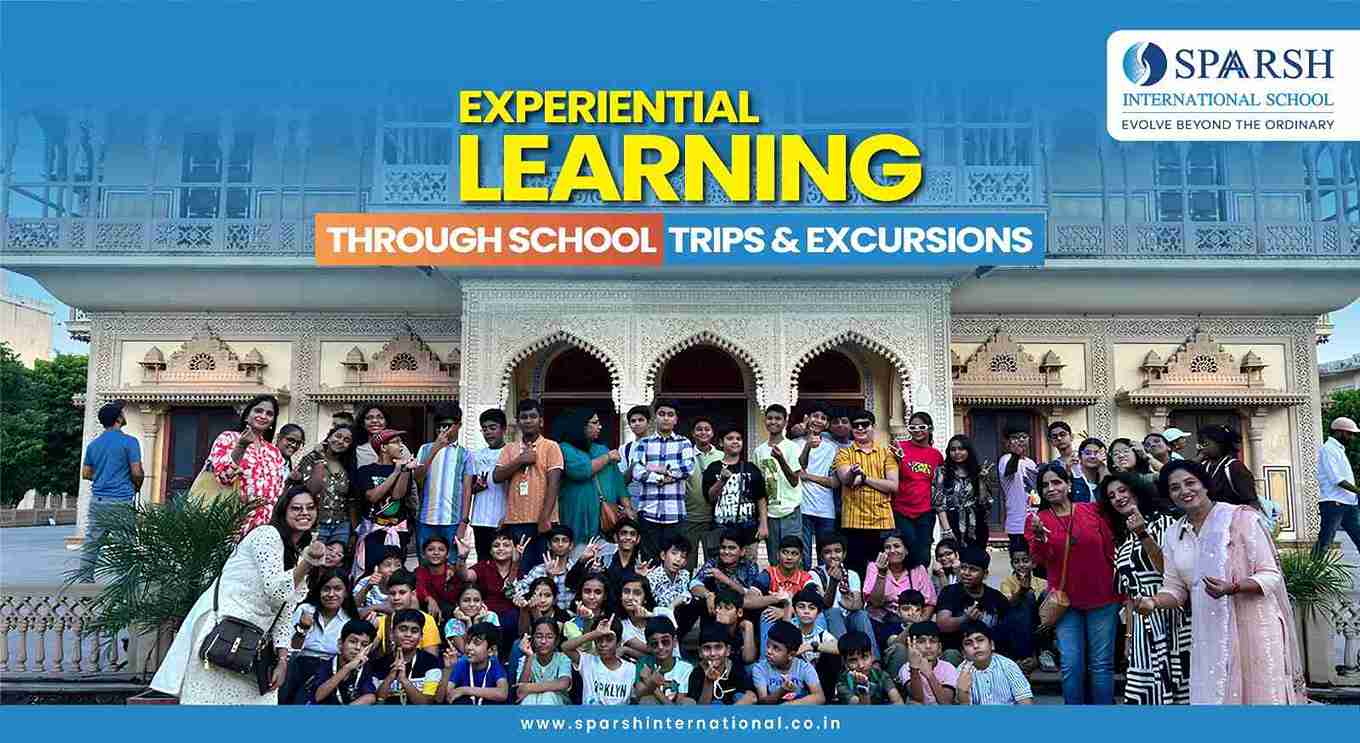
Sparsh International School plans trips and excursions with specific learning goals in mind, not just as breaks from schoolwork. Each trip is directly related to what is being taught in class. Before leaving, teachers give students useful background information. During visits, guided activities help students think about what they see, ask questions, and reflect on what they see. Assignments after a trip help students remember what they learned and see how much they got out of the trip.
SIS plans a variety of trips for students of all ages and learning styles. Younger students go to places that are closer by, where they can be watched over and do activities that are appropriate for their attention spans. Older students go on more complicated trips that require them to be more independent and think more deeply.
Visits to historical sites that are related to the Social Studies curriculum
Science centres and planetariums that help students understand theories
Environmental Studies in nature reserves and botanical gardens
Visits to factories that show how what you learn in school can be used in the real world
Cultural institutions that show students the arts and heritage of our nation
Field trips for geography students go beyond maps and diagrams. They see real landforms, rivers and ecosystems that were talked about in class. Biology trips to aquariums or butterfly parks make pictures in textbooks come to life. Students learn more when they stand where important events happened hundreds of years ago instead of just reading about them.
We know that parents worry a lot about letting school staff take care of their child's safety on trips. Before an excursion is approved, a full risk assessment is done. Staff members go to places ahead of time to check out the facilities and make plans for what to do in an emergency. The number of students to teachers on trips is higher than in regular classrooms, which makes sure that there is enough supervision.
Transportation companies have to follow strict safety rules. Our drivers possess the necessary licences and experience to ensure the safety of every pupil under our care. Before any coach leaves the premises, the vehicles undergo a full mechanical check, and we ensure that medical kits—along with staff trained in first aid—are present on every journey. Emergency contact information is kept within easy reach at all times.
Before each trip, students are briefed on the behaviour we expect and the protocols for staying safe. It is important to stress that these excursions are a privilege, rather than a right and we expect our young people to act with a high degree of responsibility. Parents will always receive a comprehensive itinerary, which details departure times, the locations visited, meal arrangements and when you can expect them back.
There is an undeniable value in taking our pupils outside the usual environment, as these experiences extend much further than the standard curriculum. Such outings provide a unique opportunity for young people to develop practical life skills that serves them well into their adult lives. Navigating public transport, looking after their own belongings and sticking to a collective schedule builds a level of personal organisation that is almost impossible to mirror in a classroom setting.
When our pupils spend time together away from the school site, their social skills flourishes in ways we rarely see during a typical Tuesday afternoon lesson. Should any minor difficulties arise, they learn the importance of working together, supporting one another and the necessity of compromise. Every one of these moments helps to shape them into the resilient, well-rounded individuals we all wish them to be.
Teachers see different parts of students' personalities that don't usually come out in class, like hidden leadership skills or creative ways to solve problems.
Cultural trips show students different ways of thinking and doing things. Going to places of worship teaches you to respect other religions. Museum visits show how different groups of people lived in the past. These experiences help people understand and care about other cultures, which is becoming more and more important in our connected world.
When students come across abstract ideas directly, they suddenly make perfect sense. Students can feel the physics principles that govern motion and force at amusement parks. After seeing how things are made in factories, chemical reactions don't seem as mysterious. When you visit a botanical garden, you can see how Math patterns work in nature.
When students stand next to real rivers and watch how they erode, deposit and flow, geography lessons about river systems become more interesting. After visiting archaeological sites that show layers of civilisation, historical timelines don't seem as random. When students visit places where famous authors lived and worked, their discussions about literature become more in-depth.
Before trips, SIS teachers plan lessons to get students ready to see certain things while they are on the trip. They give students worksheets or questions that help them focus on important educational details. After a trip, students can talk about what they saw and connect their experiences to what they learned in class.
When our pupils venture out on school trips, they are often faced with new situations that require them to adapt and think on their feet. This environment, away from the familiar, is exactly what fosters a sense of resilience and self-reliance. Our younger students find a real sense of pride in managing small tasks—perhaps keeping track of their own packed lunch or ensuring they stay with their assigned group throughout the day.
For those in the senior years, the stakes are a little higher; they must learn to manage their own time, personal belongings and perhaps even a small budget without the immediate safety net of home. These experiences are vital, as they prepare our students for the independence they will certainly need once they reach university and begin their careers. Being able to handle responsibilities and do well in new situations makes you more mature than just going to school.
Some parents are worried that trips will mess up their children's school schedules or waste their study time. At a progressive Best CBSE School in Greater Noida like Sparsh International School, experiential learning is considered an essential part of education rather than a disruption. Research shows that this is not the case. Students come back full of energy and motivation. The break from their normal routine makes them feel better mentally. When you learn something through experience, you don't have to review it as much as when you learn it the traditional way because you understand it better right away.
Families also have a valid reason to worry about the cost. We plan trips at different price points so that students don't miss out on any experiential learning opportunities because of money issues. Some trips don't cost much, while others do. We clearly tell families about costs well in advance so they can plan ahead.
Some trips are important parts of students' educational journeys. A visit to the planetarium sparks the interest of a budding astronomer. While looking at old artefacts, a future archaeologist finds their calling. During a trip to protect nature, an environmental activist becomes more aware. These life-changing events happen because students interact with the material in meaningful ways.
Students remember that history isn't just dates and names; it's about real people. Science isn't just a set of theories and mathematical solutions; it explains how things work in the world. Maps aren't boring; they show us where we live on Earth.
Sparsh International School puts a lot of attention into experiential learning programmes because we've seen how well they work over the years. Compared to students who only learn in the classroom, students who actively participate in trips show a better understanding of concepts, better memory and more excitement about learning. These results make the time and money it takes to plan good educational trips worth it.
Ans) We typically organise 3-4 major excursions annually for each grade level alongside several shorter local visits. Frequency varies by age group with older students undertaking more extensive trips. Participation isn't technically mandatory since we recognise that some families might face genuine constraints preventing attendance. However, we strongly encourage participation because trips integrate directly with curriculum content. Students missing excursions receive alternative assignments covering similar learning objectives, but these cannot fully replicate experiential learning benefits. We communicate trip schedules early in the academic year allowing families to plan attendance and manage associated costs.
Ans) Every excursion includes staff members trained in first aid and emergency response protocols. We carry comprehensive medical kits containing supplies for common issues like minor injuries, headaches or stomach upsets. For serious medical situations, we have established relationships with healthcare facilities near trip destinations and maintain emergency evacuation procedures. Parents receive immediate notification if any health concern arises requiring their attention. We collect detailed medical information and emergency contacts before every trip ensuring staff can respond appropriately to individual student needs. Mobile communication remains constant between trip supervisors and school administration throughout excursions providing additional security layers, should unexpected situations develop.
Ans) Sparsh International School organises trips with clear learning objectives. Each excursion is connected with classroom topics and includes activities that encourage observation, questioning, and reflection.
Ans) Experiential learning includes school trips, science experiments, museum visits, projects, nature walks, and group activities. These activities help students learn by seeing and doing things. They also make learning more interesting and help students build practical skills.
From Stress to Strength Promoting Mental Health in the Classroom
Parent's Checklist: Finding the Perfect School in Greater Noida
Creating a Supportive Environment Understanding the Role of Counsellors in CBSE Schools
Importance of Education for All Round Development of Children
Positive and Negative Effects of Social Media on Education
Fostering Critical Thinking Skills in CBSE Classrooms